
Have you ever brushed off a compliment about your child, or even about yourself? Maybe you brace every time the phone rings late at night. Maybe there’s a little voice that says, “Don’t get too happy. Don’t get too comfortable. Something’s about to come.” Somebody in your family may have done the exact same thing, perhaps your mother or your grandmother. What if it’s something more than how we are, something we were taught so we could survive? This essay talks about Post-traumatic slave syndrome (PTSS). There is a framework for it, and it may feel a little like looking in a mirror.
Defining Historical Trauma
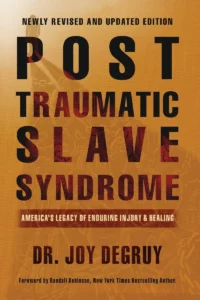 Post-traumatic slave syndrome is an explanatory framework concerned with the phenomenon of multigenerational trauma. A frequent initial response to the theory is to contend that the events in question belong to a distant past. The historical record, however, documents the capture, transport, sale, beating and experimental abuse of human beings over successive generations, a trauma that was perpetuated rather than resolved. Three centuries of trauma elapsed without redress; emancipation followed, likewise without redress, and further trauma ensued. Where a trauma is sustained, so too is its impact.
Multigenerational trauma is observable across numerous populations, including families affected by natural disaster and the successive generations of those who have endured war. Such experiences leave residual psychological and emotional effects. An examination of the African American experience, in which slavery constitutes a protracted and unambiguous trauma, discloses demonstrable connections between the survival behaviors of that era and the conduct of everyday life in the present. Many behaviors now taken for granted may be traced to those earlier survival responses.
The objection that these events occurred in the distant past is, as noted, among the most common. Yet slavery was not a discrete episode of harm. It remained lawful in this country for more than four hundred years, entailing the capture, transport, sale, beating, rape and experimental abuse of human beings, generation upon generation. Though slavery was formally abolished in 1865, neither assistance nor healing attended its end. What followed instead comprised the Black Codes, convict leasing, Jim Crow and lynching. Redlining, in turn, excluded families from neighborhoods and denied them the loans that accrued as wealth for white families.
Dr. DeGruy, a researcher and educator, designates this condition post-traumatic slave syndrome, developing the concept at length in her 2005 monograph. Her thesis is at once simple and weighty: when trauma persists for a sufficient duration, it does not remain confined to those who directly suffered it, but is transmitted across generations through the practices of child-rearing, through what one is taught to fear, and through what comes to feel permissible to say and to show.
A Mother and Child Example
This is not a diagnosis found in any medical manual. It is a theory, a framework for explaining patterns, and many who encounter it recognize something they have felt their whole lives.
Dr. DeGruy tells a story that makes some people laugh and then feel a twinge of recognition. Picture two mothers at a school meeting, one Black and one white, whose sons are classmates. The Black mother says, “I just wanted to mention that your son is doing quite well.” The white mother replies, “Oh, thank you,” and launches into the science-fair win and the uncle who is an astronaut, until she realizes that the Black mother’s son is actually doing better than her own. “Wait,” she asks, “your son is the one who’s really coming along?” The Black mother answers, “Girl, he’s a handful. He just gets on my nerves.”
When this scene is shared with Black audiences, they laugh, because they recognize at once what is happening. The Black mother is proud; she simply cannot say so aloud. It is a secret nearly every Black person seems to share. Why should it work this way? To understand, we have to roll the scene back three hundred years.
Adapting to Hostility
Consider this Black mother laboring in the fields as a white slaveholder passes and remarks that her son is coming along well. She might reply that he is not, that he is dull, idle and incapable of work. She disparages her son precisely because she does not wish to see him sold; the denigration is an act of protection. This is what the framework terms an appropriate adaptation to a hostile environment.
Consider, by contrast, a white child whose mother voices her pride in him openly; he receives her praise with ease and takes evident comfort in it. The Black child at the school meeting, meanwhile, regards his mother and wonders why she cannot bring herself to be proud of him. He has not yet been admitted to the secret, and by the time he comes to understand it, he has already been wounded by it.
Such behavior ought not to be mistaken for an absence of love. It was, rather, love in armor, an adaptation that was intelligent in its context and essential to survival. The argument is not that these mothers erred. The behavior once preserved lives, and it continued to be transmitted across generations, its origins unknown to most who inherited it, in all likelihood because the parents who passed it on did not themselves recognize its source.
PTSD Versus PTSS
Post-traumatic stress disorder is typically associated with a single traumatic event, though an individual need not have been present for it to occur; to learn that something traumatic has befallen a loved one may itself suffice. DeGruy observes that the circumstance of many Black Americans is characterized by multiple, overlaid strata of such experience. Some have undergone the trauma at first hand; others have witnessed it in the world around them; others still remain subject to oppression in the present, a condition that renders healing more difficult to achieve.
It is for this reason that she holds the phenomenon to exceed the bounds of PTSD proper. Over time, stress of this kind becomes incorporated into socialization itself. A particular manner of living and being comes to be normalized, extending from dietary practice to the very conception of what it means to be a friend. All such things are shaped by history, and in the absence of that understanding, individuals absorb as normal what is in fact historically conditioned.
The symptoms of PTSD nonetheless remain recognizable: an exaggerated startle response, episodes of anger, and a sense of a foreshortened future. Some African American children in urban environments did not expect to survive into adulthood, having been witness to so much death; some began to plan their own funerals at the ages of ten, twelve and thirteen. Chronic stress is, moreover, known to compromise immune function. Once the pattern is understood, it becomes amenable to intervention, for it is habitual, having entered into the self through the process of socialization.
This final consideration, DeGruy argues, is precisely what holds healing beyond reach, for the wound is never afforded the opportunity to close. It ceases to be something the individual consciously carries and becomes instead a constituent of how one was raised and of what one has come to experience as normal.
Physical Impacts of Stress
The children who planned their own funerals were not being dramatic. They were paying attention. Stress does not reside in the mind alone; it lodges in the body. We already know that stress erodes health through financial hardship, illness and grief. DeGruy asks what happens when the condition of being Black in America is added to all of that, what it does to one’s stress levels, and to the body’s capacity to defend itself.
Researchers have posed versions of this question for decades. One influential concept is “weathering,” advanced by the public-health researcher Arline Geronimus, the idea that relentless stress, accumulating year after year, wears the body down more quickly. The evidence is consistent with this. The CDC has documented over many years that Black women die of pregnancy-related causes at markedly higher rates than white women, even when the two groups are matched for education and income. The exhaustion people describe is not imagined. The body, as the phrase has it, keeps the score.
Pathways Toward Healing
Once these patterns are understood, they can be addressed. They are habitual, instilled through socialization, but what was learned can be examined, and what is examined can change. DeGruy holds that the first order of business is conversation, beginning with those the patterns strike hardest. Listen to them, and give them information, because people know what to do with it once they have it. From there, the wider society must be educated as well, for the assault itself has to stop.
DeGruy does not claim that therapy alone is the answer, nor that addressing injustice alone is the answer. She insists on both together, for one cannot heal in a house that is still on fire.
In practice, this can mean speaking with elders, asking where a given behavior came from and why it was always done that way. It can mean finding a therapist who understands the culture; directories such as Therapy for Black Girls and Therapy for Black Men are a sound place to begin. You do not have to carry it alone. Then decide, deliberately, what to keep and what to set down. Keep the armor that protects you. Set down the weight that only weighs you down.
Moving Forward with Pride
Our people were not broken. They were adapting their way through things most of us could never have survived, some of which, to this day, they still cannot bring themselves to speak of. And still they found a way to laugh, to cook, to pray, and to raise us up. That is not weakness. That is genius.
So the question before us now is not only how we survived, but how we heal. If any of this spoke to you, pass it on, to your mama, your cousin, your grandmama if she’s still with you, to that one friend who always insists, “I’m fine.” Let it be the start of a conversation, because none of us was ever meant to carry this alone.


