
Every couple falls out of sync. You’re not alone. One partner reaches for connection at the very moment the other needs space. Has this ever happened to you? On its own, this is ordinary — it happens in most relationships, sometimes daily. But what matters is not whether partners have different needs for closeness and distance, but how they negotiate them. That negotiation, repeated thousands of times, is a large part of what determines whether a couple feels secure with each other.
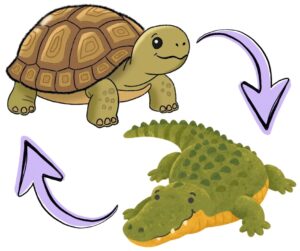 When the negotiation breaks down, it tends to harden into a predictable pattern. Researchers call it the pursue–withdraw or demand–withdraw cycle. In Imago Relationship Therapy, we often describe it with a more vivid image: the Turtle and the Alligator.
The Dance: How the Cycle Builds
The pattern is circular. The more the alligator-partner pursues — reaching, questioning, pressing for engagement — the more the turtle-partner retreats into the shell. And the more the turtle retreats, the more alarmed the alligator becomes, and the harder they pursue.
Neither partner starts the cycle; each partner’s move is a reaction to the other’s. This is one of the most important things a couple can understand. The question “Who started it?” has no answer, because the dance has no first step — only a loop. Each partner experiences themselves as responding and the other as causing.
Left unaddressed, the loop escalates. Each round confirms each partner’s worst fears, the distance between them grows, and distress deepens on both sides. Over time, many couples stop seeing each other at all and see only the pattern — the “nag” and the “wall.”
What’s Beneath the Behavior
The visible behaviors are protective strategies. Underneath each one is a fear.
- For the alligator (pursuer), the distance can trigger fears of abandonment, of not mattering, of being alone with distress. Pursuit is an attempt to restore contact — a protest against disconnection.
- For the turtle (withdrawer), intensity can trigger fears of being overwhelmed, feeling smothered, failing, being criticized, engulfed or trapped. Withdrawal is an attempt to calm down and avoid making things worse.
So both partners are, in their own way, trying to protect the relationship and themselves. The tragedy of the cycle is that each partner’s solution becomes the other’s problem: pursuit floods the turtle, and withdrawal frightens the alligator.
The Imago Lens: Why Old Wounds Show Up in New Love
Imago theory, developed by Harville Hendrix and Helen LaKelly Hunt, proposes that we are drawn to partners who in some way resemble our early caregivers — both their gifts and their limitations. The Imago is the unconscious composite image of those caregivers. Romantic love, in this view, carries an unconscious hope: that this time, with this person, the old injuries will finally be healed.
This is why the turtle/alligator dance often feels far bigger than the moment that sparked it. A partner who checks their phone during dinner, or who asks “Can we talk?” at the end of a long day, can set off reactions that belong as much to childhood as to the present. Imago calls these moments of reactivity, when the more primitive, self-protective parts of the brain take charge and the present partner gets treated as a threat.
How Attachment Gets Wired
Attachment research — among the most extensively studied areas of developmental psychology — helps explain where these reactions come from. Our earliest bonds were with our parents or primary caregivers, and the way they responded to our signals of need shaped our expectations of closeness.
Much of this learning happened before we had words. Infants cannot calm themselves; they rely on a caregiver to help settle their nervous system through holding, rocking, soothing voices, eye contact and responsive attention. This process is called co-regulation, and it is common across mammals: a cat grooming her kittens and a parent rocking a crying baby are doing versions of the same thing. When co-regulation is reasonably consistent, children gradually internalize it as the capacity to self-regulate, and they learn that reaching out to others works.
When care was inconsistent, unavailable or overwhelming — because of illness, depression, addiction, overwork, a family crisis, or simply a caregiver’s own unhealed history — children adapted. Imago understands these adaptations not as pathology but as intelligent survival strategies: ways a child and caregiver unconsciously organized themselves around the vulnerability of intimacy. The adaptation made sense in the original home. The difficulty is that it travels with us, operating largely outside awareness, into the new “home” we build with a partner.
The Turtle: The Minimizer
In Imago language, the turtle is a minimizer — someone who tends to contract their energy and feelings inward. In attachment terms, the pattern overlaps with what researchers call an avoidant (or dismissing) strategy.
Many turtles grew up in homes where emotional needs were met inconsistently, discouraged, or responded to with discomfort. The adaptive lesson was: rely on yourself; needs are a burden. These were often the “easy” children — low-maintenance, self-entertaining, rarely running to an adult when upset. Their self-sufficiency was frequently praised, which made it harder to recognize as an adaptation to emotional scarcity.
As adults, turtle-partners often:
- Value independence and alone time, and need solitude to regulate.
- Feel easily overwhelmed by intense emotion — their own and their partner’s — and by conflict or criticism.
- Share less about their inner world, which can come across as guarded, private or even secretive.
- Show emotion with low intensity, making them hard for a partner to read.
- Turn toward work, tasks and activities as a way to feel competent and settled.
- Find it hard to re-enter connection after time apart.
- Respond to feelings of inadequacy, blame or shame by distancing, going quiet or shutting down.
Turtles rarely see their self-sufficiency as connected to childhood experience. Nor do they easily grasp why behavior that feels neutral or even considerate to them (“I just needed some time to think” sound familar?) can feel like abandonment to their partner. Importantly, a turtle’s calm exterior often hides considerable internal arousal: research on withdrawers shows that many are physiologically flooded even while appearing unbothered. The shell is not indifference; it is protection.
The Alligator: The Maximizer
The alligator is what Imago calls a maximizer — someone who tends to expand their energy and feelings outward. In attachment terms, the pattern overlaps with an anxious (or preoccupied) strategy.
Many alligators grew up with care that was present some of the time and absent at others. A caregiver might have been warm one day and preoccupied the next, or emotionally overwhelmed in ways that required the child to attend to the parent’s feelings — a reversal of roles sometimes called parentification. Faced with unpredictability, the young alligator adapted by turning up the volume: crying more, clinging, protesting, becoming harder to soothe. Louder signals were the best available strategy for securing an inconsistent caregiver’s attention.
That protest carried an unspoken expectation into adulthood: people may not be there for me, so I must keep watch. The result is a finely tuned sensitivity to any sign of distance.
As adults, alligator-partners often:
- Seek closeness and reassurance, sometimes to a degree a partner experiences as clingy.
- Value emotional expression and express feelings readily and intensely.
- Communicate in a flowing, associative way, where one feeling leads to the next — which can overwhelm a partner who processes more slowly or linearly.
- Are highly expressive in face, voice and gesture.
- Struggle with separation and time alone.
- Under stress, express their longing through protest — complaining, criticizing, pressing for answers or going on the attack.
Alligators rarely recognize that their urgency is amplified by older expectations of abandonment, or that the way they reach for connection is part of what drives their partner further into the shell. Beneath the bite is almost always a bid: Please come back. Please show me I matter.
Important Clinical Nuances
The turtle/alligator metaphor is useful precisely because it is simple. But simplicity can mislead, so a few qualifications matter:
- These are patterns, not identities. Most people carry both tendencies. Many become more turtle-like with one partner and more alligator-like with another, and some partners switch roles depending on the issue — one may pursue around emotional closeness while the other pursues around sex, money or plans.
- The relationship itself shapes the pattern. Childhood history is not the only source of the dance. The adult relationship creates its own context, and repeated cycles of pursuit and withdrawal can generate insecurity in people who were not especially insecure going in. The encouraging flip side is that a responsive relationship can also create security that neither partner experienced as a child — what attachment researchers call earned security.
- Neither role is the “healthy” one. Turtles are not cold and alligators are not “too much.” Each brings a gift the other needs: the turtle’s steadiness and self-containment, the alligator’s emotional aliveness and capacity for engagement.
- Gender does not determine role. Although stereotypes cast women as pursuers and men as withdrawers, the pattern appears across genders and in same-sex couples.
- Avoid tidy brain stories. Popular writing sometimes maps these styles onto “left-brain” and “right-brain” dominance. The real difference is better described as differing strategies for regulating emotion — one by up-regulating contact, the other by down-regulating it.
- The cycle is not abuse. When “pursuit” involves intimidation, threats or control, or “withdrawal” is used deliberately to punish or dominate, the problem is not a dance of polarities, and couples work may not be the right starting point. Safety comes first.
Breaking the Cycle: The Imago Path
Imago offers a hopeful reframe: the thing your partner most needs from you is usually the very thing that is hardest for you to give — and giving it is where your own growth lies. Hendrix calls this stretching. In the turtle/alligator dance, each partner’s stretch points toward the other.
The turtle’s stretch is toward engagement. That means staying present a little longer when emotions rise, putting inner experience into words, and — crucially — announcing the need for space rather than disappearing: “I’m getting overwhelmed. I need twenty minutes, and then I’ll come back.” Then actually coming back. A pause with a promised return is a very different experience for an alligator than a door closing without explanation.
The alligator’s stretch is toward containment. That means learning to soothe some of the alarm before reaching out, slowing down, and turning complaints into clear requests: not “You never talk to me,” but “Could we have fifteen minutes after dinner to catch up?” It also means trusting the turtle’s promise to return, and letting space be space.
Together, couples can build a safe structure for connection. The Imago Dialogue — mirroring what your partner says, validating that it makes sense from their perspective, and empathizing with what they feel — slows the conversation enough for both nervous systems to settle. In this structure, the turtle has a predictable, bounded way to engage, and the alligator has a reliable way to be heard. Many couples also benefit from small rituals of reconnection after time apart, and from making specific, positive Behavior Change Requests rather than broad criticisms.
The goal is not to turn a turtle into an alligator or vice versa. It is to replace an unconscious, reactive dance with a conscious one — where both partners know the steps, understand the music, and can choose to move toward each other.
Your Turn: Questions for Reflection
- Do you and your partner consciously negotiate your different needs for closeness and space, so that both of you end up getting what you need?
- Or does an unconscious reactive cycle take over, so that the way you signal your need produces the opposite of what you want?
- In your relationship, which role do you most often play — turtle or alligator? Does it change depending on the topic?
- What does your partner’s behavior trigger in you? Does that feeling seem familiar from earlier in your life?
- What would a small stretch toward your partner look like this week?
When this dance stays unconscious, it tends to escalate, pulling both partners into survival states of fight, flight or freeze — one pursuing, the other fleeing or shutting down, both feeling more anxious, angry or numb. When it becomes conscious, the same differences that once divided a couple can become an invitation for each partner to grow.
Let’s talk.
